You chip a front tooth on a fork. Or you catch sight of a photo and notice the small gap between your two front teeth that you’ve never much liked. Or the edges of your teeth have worn down over the years and look a bit ragged.
None of these are emergencies. None of them hurt. But they’re the sort of thing you notice every time you look in the mirror.
Composite bonding is often the simplest way to sort them out- and it’s one of the treatments we get asked about most often at both our Gants Hill and Romford clinics.
So what actually is it?
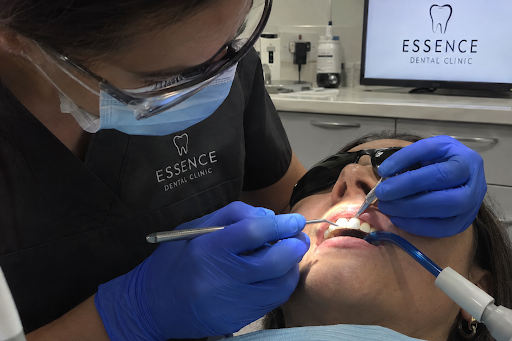
Composite bonding uses a tooth-coloured resin- the same material we use for white fillings– applied directly onto the tooth, shaped by hand, and then hardened with a curing light.
That’s genuinely it. No laboratory, no impressions sent away, no temporary covers while you wait. Your dentist builds the material up on the tooth, sculpts it to the shape you’ve agreed, and sets it there and then.
The material is matched to the shade of your existing teeth, then polished so it blends in. Done well, most people won’t be able to tell which tooth has been treated.
What can it fix?
Quite a lot, as it happens:
- Chipped or cracked front teeth
- Small gaps between teeth, generally up to around 2mm
- Worn or uneven biting edges- sometimes called edge bonding
- Teeth that are slightly the wrong shape or look too short
- Discoloured patches that whitening hasn’t shifted
- Minor overlaps and irregularities
What it can’t fix is significant misalignment. If your teeth are noticeably crooked or crowded, bonding is the wrong tool- you’d be better looking at orthodontic treatment, and we’d tell you so rather than take your money for the wrong thing.

What happens at the appointment?
Most cases are done in a single visit. For one tooth you’re usually looking at somewhere between 30 and 60 minutes.
Because so little of the natural tooth is removed, bonding often needs no injection at all. The surface is lightly roughened and a bonding agent applied so the composite grips properly, but there’s usually no drilling in the way you’d associate with a filling.
This is the part patients tend to be most surprised by. You can walk in at lunchtime with a chipped tooth and walk out with it fixed.
NB if you have decay or gum disease, that gets treated first. Bonding over an underlying problem just hides it, and it won’t hold properly on an unhealthy tooth.
How long does composite bonding last?
The honest range is about three to ten years. Five to seven is a fair expectation for front teeth, and some people get considerably longer.
Where it sits in that range depends on the tooth, how much material is used, and how you look after it. Bonding on a biting edge takes far more punishment than bonding on a flat front surface.
Two things shorten its life more than anything else.
Staining. Composite picks up colour from tea, coffee, red wine, curry and tobacco in a way natural enamel doesn’t. It can be re-polished- and having that done every couple of years makes a real difference- but it won’t respond to whitening treatment.
Grinding. If you clench or grind your teeth, bonding on the front edges will chip. We’d usually talk about a night guard before going ahead, or suggest a different approach altogether.
The good news is that when bonding does wear or chip, it’s usually straightforward to repair or refresh in one visit. You’re not committed to anything drastic. It’s worth reading our piece on how long white fillings last, since the same material behaves in much the same way.
How much does tooth bonding cost?
This is the question everyone wants answered first, so let’s be direct.
Across the UK, private composite bonding typically runs between £200 and £500 per tooth, with most patients paying somewhere around £300 to £350. Practices in London and the South East generally sit towards the upper end of that range.
The spread is wide because the work varies so much. Rebuilding a badly chipped corner takes considerably longer than smoothing a worn edge. Several teeth treated together usually work out better per tooth than one at a time.
We can’t give you an accurate figure over the phone, because it genuinely depends on what’s being treated. A consultation gets you a written quote before anything begins.
What about the NHS?
Composite bonding done purely to improve how your teeth look isn’t available on the NHS. NHS dentistry funds treatment you clinically need, and reshaping a tooth you’re unhappy with doesn’t meet that test.
There is a real exception, though, and it’s worth knowing about. If a tooth is genuinely damaged- broken in an accident, badly worn, or affecting how you bite- composite repair may be provided under an NHS Band 2 course of treatment. That’s a single charge covering the whole course, currently £76.60 in England. You can check the current NHS dental charges with the Oral Health Foundation, as they change each April.
If you’re weighing the two up, our guide to NHS and private dentistry explains where the line sits.
Is cheap composite bonding a good idea?
We’d be cautious here, and not only because you’d expect us to say that.
Bonding is a hands-on, artistic procedure. The material is broadly similar wherever you go- the difference is almost entirely in the shaping, the shade matching and the final polish. Rushed bonding looks bulky, catches the light oddly, and stains faster because the surface hasn’t been finished properly.
The other issue with heavily discounted bonding is time. Doing it well isn’t quick, and a price that assumes fifteen minutes a tooth tells you something about how long you’ll actually be in the chair.
If you’re comparing quotes, two things are worth asking for. First, before and after photographs of that dentist’s own work rather than stock images. Second, confirmation that whoever is treating you is registered with the General Dental Council, whose register is public and free to search.
You can see examples of our own work in the smile gallery, and read what patients have said in our testimonials.
One thing to sort out first
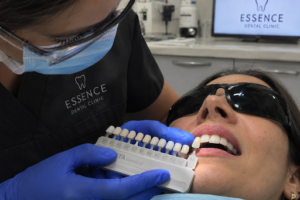
If you’re thinking about whitening as well, whiten first.
Composite doesn’t whiten. If you bond your teeth and then whiten them, the natural teeth lighten and the bonded areas stay exactly as they were- and the work that used to blend in suddenly doesn’t.
Whiten, let the shade settle for a couple of weeks, then match the bonding to the new colour. Our teeth whitening page explains the options, and if you’re worried about sensitivity afterwards, we’ve written about why that happens and how long it lasts.
Bonding or veneers?
Veneers are thin porcelain shells bonded to the front of the tooth. They resist staining better and generally last longer.
The trade-off is that fitting them usually means removing a layer of enamel, and enamel doesn’t grow back. Once you’ve had veneers, you’re committed to having something on those teeth for good.
Bonding removes little or nothing, costs roughly half as much, and is done in a single visit. For smaller corrections it’s often the more sensible starting point- and it doesn’t close the door on porcelain veneers later if you decide you want them.
Looking after it
Nothing complicated, but it does make a difference:
- Brush twice daily with a soft brush- aggressive brushing scratches the composite surface
- Go easy on ice, nuts and anything you’d describe as crunchy, at least on the bonded teeth
- Don’t use your teeth to open things
- Keep up with hygienist appointments– plaque collects at the edges of any dental material
- Ask about a re-polish every couple of years
Is it right for you?
Composite bonding tends to suit you if there are a few specific things you’d like improved, you’d rather not have a healthy tooth removed, and you want it sorted quickly.
It’s less likely to suit you if you grind heavily, if you’re after a complete change of tooth colour and shape, or if the real issue is alignment rather than shape.
The genuinely honest answer is that it depends on your teeth. We can usually tell you in about ten minutes whether it’s the right approach- and if it isn’t, we’ll say so.
Thinking about composite bonding? We see patients at both our clinics- Gants Hill on 0208 554 5691 and Romford on 01708 346 212. Book a consultation and we’ll give you a straight answer about whether bonding is the right fit, along with a written quote before anything starts. You can also get in touch online.